Article by Carl Harrison, Conway Hall Historian and Honorary Archivist, drawing on a recent display of archival material, curated for the Bloomsbury Festival.
Note: Shaw insisted on his own spellings of certain words. In particular, he omitted the ‘u’ from words such as humour, colour and vigour. These appear as published in the quotes which follow.
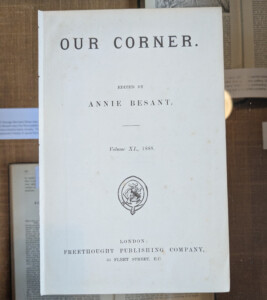
Our Corner title page, 1888
OUR CORNER
From 1883-1888 Annie Besant published Our Corner, a monthly ‘family’ magazine and ‘mouthpiece in my Socialist and Labour propagandist work’. Conway Hall Library has a complete set. Earlier numbers included ‘Corners’ for children, arts, literature, science, gardening, freethought, women’s issues, poetry, fiction, and more. Later issues focussed increasingly on socialist, labour and Fabian politics. Our Corner was also a vehicle for Annie’s autobiographical and Charles Bradlaugh’s political writings.
NOVELIST
From 1880 George Bernard Shaw, in his twenties and in London, was trying to live solely from his writing. His initial plays and novels had little success, but from the mid 1880s he began to make a mark as an arts critic, before major success as a playwright with ‘Arms and the Man’ in 1894. Four early novels, none commercially successful, were first published in serial form, two of them, The Irrational Knot and Love among the Artists, in Our Corner. Annie Besant is said to have published the last issues of Our Corner only in order to complete ‘Love among the Artists,’ which took up half of them.
By this time Shaw had abandoned novels. Love among the Artists’had been completed as far back as 1881 and Shaw’s address to the reader was dismissive: ‘“Love among the Artists” is what is called a novel with a purpose. I will not undertake to say at this distance of time what the main purpose was’. As the critic James Agate quipped, ‘Shaw’s plays are the price we pay for Shaw’s prefaces’.
CRITIC
Shaw’s other contributions to Our Corner were criticism and political essays. Between June 1885 and September 1886 fifteen of his ‘Art Corner’ reviews appeared. Annie Besant was said to have been the first publisher to pay him for such contributions. Shaw’s reviews were largely of art exhibitions, theatre and music performances. The distinctive sardonic Shavian tone was already evident.
The first, in June 1885, is of the annual exhibition at the Grosvenor Gallery, where he cannot resist reference to the Gallery’s ‘deep green walls’ (the ‘greenery-yallery, Grosvenor Gallery’ tone famous from Gilbert and Sullivan’s ‘Patience’), contrasting with the shower of gold in a painting of Danae, to ‘carry out a delightful scheme of color’. (Serious or ironic?) Elsewhere he singles out the ‘prodigious noses with which this artist invariably decorates his figures’.
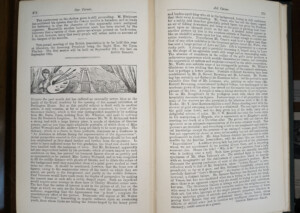
Shaw’s first article in Our Corner, June 1885
In March 1886, he sees ‘Sir John Millais’s new picture, “Bubbles” … As all its merit is in its coloring, those who do not make its acquaintance until it is engraved will probably condemn it as a frivolous claptrap. It represents a pretty little boy in a clean frill and velveteen tunic blowing bubbles.’ In May 1886, displays of Pre-Raphaelite artists prompt a comparison of the early brilliance of Dante Gabriel Rossetti with the earnestness and ‘prodigious expenditure of elbow grease’ of William Holman Hunt, and his ‘gentle exercise of an imagination which never takes the British public out of its depth’. (Quietly putting down both artist and audience.)
In music, he declares (July 1885) ‘our grandiose and sensationalist nineteenth century music is completely beaten by Mozart’. He contrasts how ‘the power of music to produce hysterical excitement when used – or abused – solely as a nerve simulant, which is the only power that the nineteenth century seems to value it for, is used by Mozart with exquisite taste and irresistible good humor to relieve the audience from the earnest attention compelled by the more serious parts of his work’. (Another gentle put-down.) He offers a back-handed complement to Sir Arthur Sullivan, whose ‘care and refinement have greatly improved the performances of the Philharmonic orchestra, but who certainly kills the music he conducts when vigor and impetuosity are required’.
In April 1886 he misses Liszt’s last visit to London and so (May 1886) has ‘nothing to add to what can be gathered from the daily papers about the man who is dividing public attention with Mr. Gladstone’. (Referring to Gladstone’s First Home Rule Bill for Ireland, which ended his brief 1886 premiership.)
In the theatre, Shaw is censorious of Arthur Wing Pinero’s ‘The Money Spinner’ (August 1885), a ‘clever comedy which interests the audience until the curtain descends, when they go away rather disagreeably effected’ by the quasi-criminal characters presented. A drunken aristocrat ‘is the only tolerable person introduced, because he is the only one that does not claim more sympathy than he deserves’.
He also dislikes early Shakespeare. Seeing ‘Love’s Labours Lost’, in August 1886, he is dismissive equally of the performances, (‘His qualifications, so far, are those of an artist’s model: he has yet to make himself an actor’) and of the play itself. The male characters are ‘would-be wits, with their forced smartness, their indecent wiggeries, their snobbish sneers at poverty, and their ill-bred and ill-natured mockery of age and natural infirmity … Among people of moderate culture in this century they would be ostracised as insufferable cads’.
POLITICAL POLEMICIST
From 1882 Shaw was also deeply interested in economics, social issues and politics. His interest was sparked by the American social theorist and economist Henry George and his hugely influential book, Progress and Poverty (1879). From 1884 he was a leading figure in the Fabian Society; his political activism continued through the 1890s, until overshadowed by his growing success as a dramatist. He was a Fabian delegate to the 1893 conference establishing the Independent Labour Party (though sceptical of its prospects of success), and successfully proposed resolutions to abolish indirect taxation, and tax unearned income ‘to extinction’, policies he had advocated in Our Corner. He was elected a St Pancras vestryman and borough councillor between 1897 and 1903; he is unmistakeable on the right of a group photograph of the Borough Council. He was initially enthusiastic, publishing a tract on The common sense of municipal trading as late as 1904, but, already by 1903 he thought, “After six years of Borough Councilling I am convinced that the borough councils should be abolished”.
Shaw’s four lengthy political essays in Our Corner set out his theories of economics, politics and social structures, and his advocacy of ‘gradualism’ – ‘the necessity for cautious and gradual change’ to Socialism. With vivid illustrations, they display a belief in progress co-existing with an innate pessimism with regard to human nature. Two essays, The Transition to Social Democracy and The Economic Aspect of Socialism were reprinted verbatim in Fabian essays in socialism (1889), edited by Shaw, and which included also Industry under socialism, by Annie Besant.
‘Concerning Interest’ is a full on attack on capitalism and the economic and philosophical arguments used to justify it. Shaw outlines the ill effects of Individualism, as exemplified by the charging of rent and interest, then goes on to argue for the nationalisation of rent from land, on the classic basis that ‘Land obviously belongs no more to one man than to another, since no man made it’. Interest on capital is ‘an excuse for an idle man to live on the labor [sic] of any industrious one’. He describes how the capitalist social system rests on class divisions between ‘proprietors’, ‘employers’ and workers, and also within the ‘proletariat’. Opportunities for success through ‘talent’, without property or capital, are largely illusory. One senses him self-satirising: ‘If he were a propertyless John Ruskin he would support himself … by writing gushing prefaces to the catalogues of fashionable Bond Street picture galleries, or by acting as “art critic” to one of the papers’. A Socialist State would nationalise capital as well as land. Any collateral hardship to ‘a few thousand old ladies and gentlemen’ would be outweighed by ‘the hope of relieving millions of workers’ and their descendants. The ‘national landlord’ would force industrialists to give up their production to the workers, or workers’ enterprises would put them out of business. In passing he condemns most existing buildings as a ‘public nuisance’, and their machinery as only suitable for producing unnecessary luxuries. He is, he says, a ‘scientific Socialist’, in contrast to ‘the old-fashioned Utopian Socialist’ or ‘the many sentimental Socialists of to-day’.
A Refutation of Anarchism counters an essay on State Socialism and Anarchism, by Benjamin R. Tucker, an American Anarchist. He dismisses Tucker’s classical economic argument that ‘labor [sic] is the true measure of price’, arguing that external circumstances, such as good or bad land or market opportunities, are equally or more significant. To argue otherwise is equivalent to arguing the wind is driven by the falling leaves. The Anarchist proposal to make the occupier of land its owner would simply privilege those with the best land. While the ‘economic problem of Socialism is the just distribution of the premium’, Anarchism is ‘Individualism carried … near to its logical completeness’, and hence the ‘negation of Socialism’.
The second part of the essay is a witty and impassioned diatribe, echoing his plays, against Tucker’s idealistic vision of an Anarchist society governed by individual conscience and public opinion. This, like government-imposed Communism, is entirely unrealistic given the current debased level of human nature, since ‘we are hogs’. The best compromise is a Social Democratic state, owning the land but not yet fully Communist, and leaving the individual some remaining power and protection through democratic institutions. The movement towards this new organisation of society will be slow, organic but inevitable, driven by international competition and the ‘irritation’ of ‘the unemployed and the underpaid’. All counter arguments of the theorists or vested interests are dismissed with satirical Shavian flourishes, since ‘society is an automatic machine in the main’.
In The Transition to Social Democracy (November 1888), Shaw stresses again the ‘gradualist’ viewpoint, reassuring that there is nothing ‘sudden or sinister’ in his approach. Historically, the orderly, feudal England broke into chaos, the ‘automatic regulator in Competition’ failed, now ‘Social Democracy was working itself out’. This must mean land, capital and industry passing ‘from the class which now appropriates it’ to a reformed, democratic State. The extension of the franchise, the introduction of Income Tax, the Factory Acts and the growth of Trades Unions show the transition already under way. The remaining steps to Social Democracy require the ‘consummation of Democracy’: ‘manhood suffrage, abolition of all poverty disqualifications, abolition of the House of Lords, public payment of election expenses, public payment of representatives, and annual Parliaments’. These he regards as inevitable, though the ‘monstrous’ exclusion of women from the franchise must wait. A reformed local government, the ‘democratic municipality’, will be ‘the machinery for Socialism’, led by municipal relief works and a wave of municipal enterprises until ‘Eventually the land and industry of the whole town would pass by the spontaneous action of economic forces into the hands of the municipality; and, so far, the social problem would be solved’.
He ends with a vision of the ‘extinction of private property’, and the ‘Local Government Board of the future’ effectively supplanting Parliament, leading a total transformation of politics and society. But in the meantime the Social Democrat must focus on a ‘humdrum programme’, since the debased ‘human product of nineteenth century civilisation’ cannot produce the ‘army of light’ to force revolutionary change. With regret he endorses the ‘sordid, slow, reluctant, cowardly path to justice’.
The ‘The Economic Aspect of Socialism’ opens with a florid extended illustration of the growth of ‘Private Property, ‘from its source in cupidity to its end in confusion’, from the first Adam ‘on the make’, to the creation of a landless Proletariat and a ‘direct traffic in men’. Just as oversupply of goods reduces their value, so over population means that ‘English laborers today … are no longer even dirt cheap’. He becomes heated. ‘The more you degrade the worker and rob him of all artistic enjoyment in life, the more you will throw him back, reckless, on the one pleasure left to him … they breed like rabbits; and their poverty breeds filth, ugliness, dishonesty, disease, obscenity, drunkenness, and murder’, to which ‘you’ respond with ‘paroxysms of frantic coercion, followed by paroxysms of frantic charity’.
Dismissing the obscure terminology and specious arguments of economists, he argues scarcity and rent set the ‘values of commodities’ since plentiful things such as ‘air … have no exchange value, while scarce trinkets fetch immense prices’. Fashion also plays a part; so there could be a rise in the value of tambourines when ‘the exertions of the Salvation Army might create such a demand’.
All attempts to construct ‘true societies’ upon private property have failed. ‘Civilizations … have rotted … and eventually been swept away by uncivilized races … Our own civilization is already in an advanced stage of rottenness’. So ‘public property in land is the economic basis of Socialism’. Rent, pensions, interest, will be ‘discontinued’, ‘added directly to the incomes of the workers’, or held in common as taxation revenue. ‘The expenses of international brigandage would probably dwindle, whilst those of national insurance … would certainly become of the first importance’.
His conclusion is rousing. ‘The economic problem of Socialism is thus solved’. With this, ‘a terrible weight will be lifted from the minds of all except those … clinging to the present state of things from base motives’ or folly. The guilt of feeling ‘that the poor must starve and make you feel ashamed of your dinner’ is replaced with hope: ‘though the evil is enormously worse than we knew, yet it is not eternal – not even very long lived, if we only bestir ourselves to make an end of it’.
POSTSCRIPT: CONWAY HALL SUPPORTER
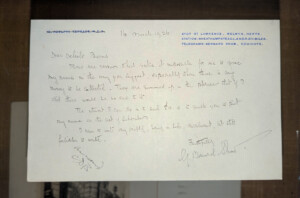
Letter from Shaw regarding Conway Hall appeal, 1926
40 years later, in 1926, the Ethical Society had acquired, a long last, a new site on Red Lion Square to replace South Place Chapel. An appeal fund was launched to build Conway Hall, and the great and good approached. Shaw, now a cultural colossus, seems to have been asked to promote the appeal. His letter in reply, on 16 March 1926, has to be brief, ‘being in bed, convalescent, but still forbidden to write’. Though sympathetic he is unable to accept as ‘if I did there would be no end to it’. Instead he sends 10 guineas and agrees to be listed as a subscriber.